Why Shop With Us?
Free Shipping
Free Standard Ground shipping (48 contiguous states, some overweight and Used/Vintage items excluded).
Orders placed before 3 p.m. ET usually ship the same business day.
Learn More2-Year Free Warranty on Guitars
Every guitar or bass you purchase from Musician's Friend (electric or acoustic, New or Open Box) includes two years of protection from manufacturer defects.
Contact Us for DetailsWe're Here for You
Our Gear Advisers are available to guide you through your entire shopping experience. Call or Chat for expert advice and to hear the latest deals.
Contact UsContact Us
Hablamos Español
866.226.2919
Hours:
MON - FRI 6 AM – 7 PM PT
SAT 7 AM – 6 PM PT
SUN 8 AM – 5 PM PT


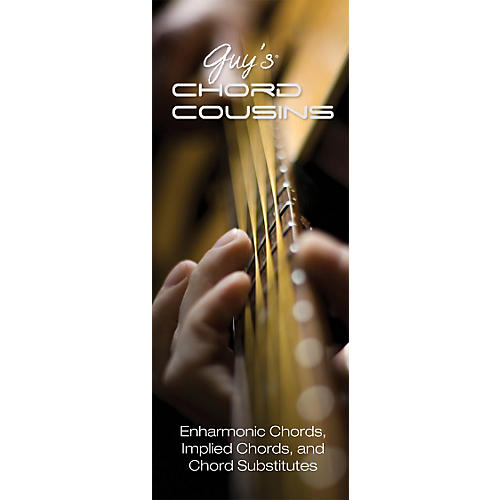
Guy's Chord Cousins
false falseWe're sorry-this item is unavailable.
Contact our experts for a recommendation of great alternatives. Call us at 800-449-9128.
Explores how certain sets of chords are closely related in a way that many players may not realize for a way to simplify your playing.
What are Chord Cousins?
The author coined this term to refer to two chords that meet the following criteria:
1. The root notes of the two chords cannot simply be enharmonic (i.e., the same note with a different name), e.g. G-sharp and A-flat or the root note in either chord may be omitted in any particular voicing without disqualifying the chord as a Chord Cousin. (For example, a no-root voicing of G6/C presented as a Chord Cousin to Cmaj9.)
2. The two chords must either have the same spelling (in which case the one chord is said to be "enharmonic" with the other) or have very similar spellings.
3. At least one of the two chords must serve as a viable chord substitute for the other.
Chord Cousins are pervasive in music. Why? One reason is that many popular chords are actually comprised of two simpler chords. For example, every maj7, m7, and dom7 chord is composed of two triadic chords. Consider the Cmaj7 chord. The lower triad - the root, 3rd, and 5th - is a C major chord, while the upper triad - the 3rd, 5th, and 7th - is an Em chord. As might be expected, the Em chord can be played as a substitute for the Cmaj7 chord, when the C root is being played by another instrument. It's easy to see why the Cmaj7 chord and the Em chord qualify as Chord Cousins: First, they have different root notes - C and E. Second, they have similar spelling - with only one note differentiating the two chords. And, third, as mentioned, the Em chord can serve as a substitute for the Cmaj7 chord.
Sometimes the relationship of chord cousins is less obvious. For example, even an intermediate guitarist may not readily recognize that every maj7 chord is closely related to an m9 chord (having a root note a minor 3rd interval lower). Consider the spelling of Gma7 and Em9. Gmaj7 is spelled G-B-D-F-sharp, and Em9 is spelled E-G-B-D-F. The only difference in spelling is the E note, which appears in Em9 but not in Gmaj7. Therefore, by adding an E note to any Gmaj7 chord form, we obtain the Em9 chord. If we place this added E note below the Gmaj7 chord (written, "Gmaj7/E"), then we obtain a root-in-bass voicing of Em9. Of course, understanding this relationship - in merely a theoretical sense - is only half the battle. The other half is gaining a "working knowledge" of this musical relationship by spending time with the various related chord forms.
The Usefulness of Chord Cousins
Learning about chord cousins is important for several reasons. First, studying chord cousins will equip the student to gain a valuable perspective on chord construction - one that generally comes much more easily to pianists. A pianist playing an Em7 chord will typically play a G major triad with the right hand and an E bass note (or possibly two E notes an octave apart) with the left hand. Because of this separation, the triad-over-bass construction of the Em7 chord is very apparent. The guitarist does not come to this realization quite as easily, as only one hand generally does all of the fretboard work.
Second, Chord Cousins can often be used in chord substitution - a common feature of jazz compositions. For example, a chord progression in "The Girl from Ipanema" by Antonio Carlos Jobim might be understood as using a G7 chord as a "substituted" chordI'm in place of an "expected" C7 chord (which is the V chord in the harmonized F major scale).
Third, the relationship of chord cousins can also be used for solo improvisation. A very common example is to utilize the upper triad in a "7th" chord (i.e., a maj7, dom7, m7, m7(5), or dim7 chord - or alteration thereof). For example, a soloist who knows that an Emaj7(+5) chord is equivalent to a G major triad over an E bass note can achieve very nice results by simply playing a G major triad over the Emaj7(+5) chord, if the E root is being played by another instrument.
Finally, the study of chord cousins can enhance memory recall. Just as the presentation of chord forms by "family" (as done in Guy's Grids: More than a Chordbook) provides for contextual learning, so also the presentation of chord forms in chord cousin sets can greatly enhance memory recall by providing yet another context for learning.
Please note that all of the chord forms presented in this book are moveable chord forms - meaning that you, the guitarist, can play them up and down the fretboard. To illustrate, a C7 chord form can be moved up one fret and it becomes a C7 chord form. Likewise, it can be moved up another fret, and it becomes a D7 chord form, etc.
Features
- Explore sets of chords that are closely related, but not in an obvious way - including enharmonic chords, implied chords, and chord substitutes
- Gain a valuable new perspective on chord construction ” one that generally comes much more easily to the pianist who routinely plays a triad with the right hand and a different bass note with the left hand
- Utilize chord substitutes to enhance jazz and popular music
- Develop interesting and sophisticated solos based on chord cousin relationships
- Improve chord-form memory recall through the study of related chord forms
Order this non-traditional take on guitar playing today!
- Free Standard Ground shipping (48 contiguous states, some overweight and Used/Vintage items excluded).
- Orders placed before 3 p.m. ET usually ship the same business day.
Every guitar or bass you purchase from Musician's Friend (electric or acoustic, New or Open Box) includes two years of protection from manufacturer defects.
Our Gear Advisers are available to guide you through your entire shopping experience. Call or Chat for expert advice and to hear the latest deals.

Musician's Friend Support