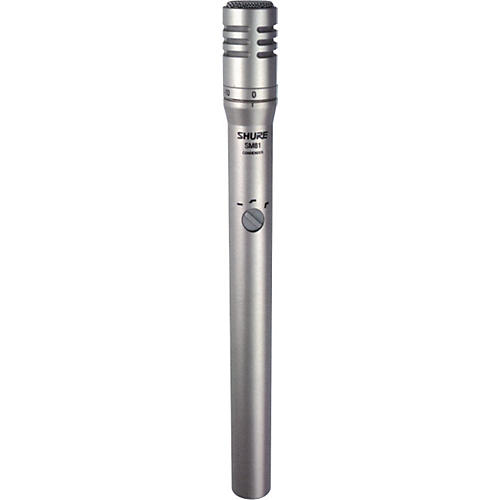
Shure SM81 Condenser Mic  

SKU 
#270171000000000
  • MSRP:
    $562.02
  • Your Savings:
    - $213.02
  • Free Shipping on Orders over $49
  • Your Price:
    $34900

In Stock & Ready To Ship

Gold Coverage: (What’s This?)

(Most Popular)
+ Add to Wishlist
Shure

A studio standard for miking acoustic guitar, piano, and cymbals.

The Shure SM81 Condenser Mic is a unidirectional cardioid mic with studio, broadcast, and sound reinforcement versatility. Its wide frequency response, low noise, low RF susceptibility, and rugged construction allow it to excel in all applications. It is furnished with a swivel adapter, 10dB attenuator with locking switch, a 3-position low-cut filter, foam windscreen, and a case for carrying and storage.

The SM81 requires phantom power.

Features

  • 20Hz-20kHz frequency response
  • Flat response curve for accurate reproduction of sound sources
  • Low noise and high output clipping level
  • Low distortion over a wide range of load impedances
  • Cardioid polar pattern with maximum rejection and minimum coloration of off-axis sounds
  • Low RF susceptibility
  • Selectable low-frequency response: flat, 6, or 18dB/octave roll-off
  • Phantom powering
  • Rugged steel construction
  • Field-usable over a wide range of temperatures and humidities

Get it. You'll use this mic a lot.

SM81 Condenser Mic Specifications:

  • Type: Condenser (electret bias)
  • Frequency Response: 20 to 20,000Hz
  • Polar Pattern: Cardioid (unidirectional) response-uniform with frequency, symmetrical about axis
  • Output Impedance: Rated at 150Ω (85Ω actual)
  • Recommended minimum load impedance: 800Ω (May be used with loads as low as 150Ω with reduced clipping level)
  • Output Configuration and Connector: Balanced, transformer-coupLED output; male XLR connector
  • Sensitivity (at 1,000Hz): Open Circuit Voltage: -45dBV/Pascal (5.6 mV), (1 Pascal = 94dB SPL)
  • Clipping Level (at 1,000Hz): 800Ω Load: -4dBV (0.63 V), 150Ω Load: -15dBV (0.18 V)
  • Total Harmonic Distortion: Less than 0.5% (131dB SPL at 250Hz into 800Ω load)
  • Maximum SPL: (at 1,000Hz): 800Ω load: 136dB (attenuator at 0) 146dB (attenuator at -10), 150Ω load: 128dB (attenuator at 0) 138dB (attenuator at -10)
  • Hum Pickup: -3dB equivalent SPL in a 1 mOe field (60Hz)
  • Self-Noise (equivalent sound pressure levels; measured with true rms voltmeter) 16dB typical, A-weighted, 19dB typical, weighted per DIN 45 405
  • Signal-to-Noise Ratio: 78dB (IEC 651)* at 94dB SPL, *S/N ratio is difference between 94dB SPL and product's equivalent self noise (SPL A-weighted)
  • Overvoltage and Reverse Polarity Protection: Max. external voltage applied to pins 2 and 3 with respect to pin 1: +52 VDC, Reverse polarity protection: 200 mA max. (diode-clamped)
  • Polarity: Positive pressure on diaphragm produces positive voltage on pin 2 relative to pin 3
  • Cartridge Capacitance: 54 pF
  • Low Frequency Response Switch Positions: Flat; -6dB/octave below 100Hz; -18dB/octave below 80Hz
  • Attenuator Switch Positions (Lockable): 0 or -10dB
  • Power: Supply Voltage: 11 to 52 VDC, positive, pins 2 and 3, Current Drain: 1.2 mA max
  • Environmental Conditions:
  • Temperature:
  • Storage: -29° to 74° C (-20° to 165° F)
  • Operating: -6.7° to 49° C (20° to 120° F)
  • Humidity:
  • Storage 0 to 95% relative humidity at room temperature (72° to 80° F, 22° to 27° C)
  • Case: Steel construction with vinyl metallic paint finish and stainless steel screens
  • Dimensions (D x W): 212mm x 23.5mm, 8.3" x .93"
  • Weight Net: 230g (8oz.)
Write a Review Overall Rating Customer Reviews 32 See all 32 customer reviews...

live banjo

| Review By: william humphries | 1 week, 4 hours ago

0 people out of 0 found this review helpful

Features:

I used the SM81 for the first time last week with a Fishman Loud Box Artist live outside. The sound at this venue is horrible i've been playing there 6 years and have never been able to hear myself. unless i plugged in and then I would sound like a cheap knock off of a Fender Strat. But with these two items I could hear myself and I sounded like i do at home which in turn helped my playing .

Recomend this mic. for any stringed instrament

Quality:

amazing quality would give it a 10 but i know for more money you can get better quality but for the price you can not do any better.

Value:
Overall:

.

Do you own the product?:
Yes
Have you used the product?:
Yes
Musical Experience:
Banjo player 12 years same band
Style of music you play:
Bluegrass-klezmer
Where you live:
Nantucket,Ma.

Did you find this review helpful? yes no1124025

True multi purpose mic

| Review By: Steven Gilchrist | 6 months, 2 days ago

6 people out of 6 found this review helpful

Features:

The cardioid cap on this mic is very helpful when using it in a live sound reinforcement role. Very good feedback rejection and nice open grilles before and after the diaphragm give this mic a flat response curve. You can get a 'livelier' mic, but that just means you have to eq the heck out of it if you're going to use it in live applications.


Switchable LF rolloff slope from none to gradual to steep means you have three mics in one with the same cap. Use it flat as a live choir mic or for recording an orchestra direct to 2 track master. Use it rolled off for close miking a piano or snare. With attenuation and variable/defeatable bass rolloff the 81 is a very flexible SDC.


I have a pair of omni caps for mine. I put those in when I'm recording a classical gig. Place them 18 inches apart on a mic bar and make sure they are equidistant from your source, and you can create magic from a chamber group to full orchestra or choir.

Quality:

Standard Shure. Thick steel case that you can pound nails with. I've had my 81s for going on 25 years now and they don't look as pretty as they used to. But they still sound great. If one of them craps out I'll probably have it refurbed if it costs less than new--vintage Shure is a GOOD thing.

Value:

I picked these up at a great price for the pair back in the olden days on good sale. Can't tell you how worth it they have been. If you have ambitions of recording for years into the future this workhorse will be with you a long time--and you can make it work well in more situations than any other mic I'm aware of.


I have a very nice LDC vocal solo mic, a bag of SM57s and 58s, a couple of very specific AT and AKG recording mics and some other specialty mics for sound reinforcement. Each one has its place and if I didn't have a wireless lav mic I'd have to buy one. The 81 is not the 'mic for everything.' But it sure is close. I use these more than everything else combined.


I've drooled over some very expensive Neumann SDCs as well as some of the Senn and AKG and other fantastic distance recording mics. The SM81 is cheaper by far than all of them. It's almost like cheating. You can buy more sensitivity and you can buy greater feedback rejection (though probably not in the same mic). You might even be able to buy a flatter response curve.


But the 81 is a tool you should learn to use properly because you will find them everywhere and it can get the track for you if you deploy it right. I trust these mics in many more situations now than I did when I got them.


There are other cheaper SDCs out there, and some are even pretty good. I had a pair of MXL 604s modded to upgrade their electronics and improve the physical placement of the diaphragms to reduce unwanted reflective colorations, and more money later I now have another pair of very sweet sounding condensers with both cardioid and omni caps. Dollar for dollar I'd say the modded MXL was a better deal because the Shure omni capsules are a HTF collectors item these days and you just can't get them.


Christmas concert season is just getting underway, and I'll be working almost every night for the next month. I always default to the SM81s because I know the results will be good. But I'm planning to set up a double bar for a show this year and get one recording from the modded MXLs and the identical recording from the 81s so I can A-B them and find out just what I'm looking at with strengths and weaknesses.


Even if the modded MXL sounds every bit as good as the Shure, I'm quite certain it will not hold up for 30 years like the Shures have. So stone cold longevity gives the SM81 10 stars for the best value in mics that I've used, right up there with the SM57 and 58. Shures are the Energizer Bunny of microphones.

Overall:

If I were rating these on an initial purchase scale this would be 8 or 9 stars for flexibility, recording sound quality and usability in live sound reinforcement. But as I've pared down my kit and gotten to a lean, mean recording machine, the 81s are the mics that go in my bag. When I am asked to help with sound reinforcement for church music events, the 81s are super sweet as choir mics with the cardioid capsule for directional feedback rejection. They are super easy to EQ--basically you're EQ'ing the house, not the mic. With omni caps they fit on a mic bar and plug directly into my Marantz PMD661 for direct-to-2-track mastering of solo instrumentals, chamber groups, choirs, orchestras...any non-amplified performance. I carry my "classical recording kit" in a single small bag plus a stand. If I really need to punch it up, I can add my portable 2-channel mic pre with its beautiful-sounding compression and eq circuits. Works off 2 9-volt batteries. Honestly, if I know the venue and have had good luck in the past I leave the preamp at home. These mics are honest enough to just make needed corrections via placement as long as you're in a decently-designed venue.


Longevity and reliability make up a good portion of my approval of these mics. Amortizing the cost of these mics, I'd be surprised if I paid more than a nickel per mic for each time I've used them. Now that's some smash mouth value right there, due to the durability of these mics. Never had a failure, and I can't tell mic 1 from mic 2 in SQ either, even after all these years.


They have recorded guitar solos in living rooms all over my region. Setup of SDCs is so simple compared to the more stringent requirements of a large diaphragm mic. Sensitivity is high, frequency response is wide and flat, flexibility is great with multiple response curve settings. Talk with me or play a few notes in the room we're going to record in, and I can usually pick out the spot where I want to set up the 81s  in very short order just by listening for the spot in the 3 dimensional space where it sounds just right for a good stereo recording. Generally the 81s like to be slightly closer to the ceiling than the floor in a small room, and slightly closer to the floor in a large one--though you shouldn't place them closer than 5 feet to the floor if you can help it.


The SM 81 is a world standard recording mic with proven application in stand-mounted sound reinforcement for live choirs and chamber groups. If you do some of both, 2 or 3 of these will be among your most used tools. After your 30 year mark, you'll probably be as attached to yours as I am to mine.

Do you own the product?:
Yes
Have you used the product?:
Yes
Musical Experience:
bass player, recordist for about half the high schools in the area's orchestras and bands
Style of music you play:
Jazz and classical
Where you live:
Central PA

Did you find this review helpful? yes no1098914

SM 81's are all you need to mic your drum kit

| Review By: James Eddy | 9 months, 3 days ago

1 people out of 1 found this review helpful

Features:

Over the years, I "close mic'd" my drum kit (in the studio) with SM57s and some other "drum mic sets" but never seemed to get that really "phat" sound from the kit (exclusive of the kick).  Then, while at a "doo wop" concert in Wilmington, DE, the drum sound coming through the PA system was so strong and phat that at the end of the concert, I asked the sound guy what they were using to mic the kit.


He informed me that except for a kick mic, they had two SM 81s overhead on the left and right of the kit.  I went out and purchased the SM81s and man, do they ever just rock the studio in terms of the sound they give to the kit.  Besides providing an overall "phat" sound, they beautifully pick up the ride, crash and hi-hat cymbals and, when you are mixing, if you take off the "high" to minimize cymbals, it does not affect the mids and lows that the 81s also provide.


If you are looking to reduce the number of mics you use either live or in the studio, the 81s are the trick.  I use them, an AKG D112 on the kick and an SM 57 under snare and that is it........spend the extra money on the SM81s, you will not be disappointed.

Quality:
Value:
Overall:
Do you own the product?:
Yes
Have you used the product?:
Yes
Musical Experience:
40+ years
Style of music you play:
R&B
Where you live:
PA

Did you find this review helpful? yes no1094132

Shines even as a vocal mic

| Review By: Anonymous User | 1 year, 4 months ago

1 people out of 1 found this review helpful

Features:
Quality:
Value:
Overall:
The first experience with this mic was almost two years ago.  An expert studio engineer used one on a Bogner 4X12 when recording lead guitar solos.  It is the best lead tone I ever achieved.  Finally I purchased an SM81 from Musicians Friend for use in the studio.  It works great for everything, even vocals.  Probably one of the better tests of an instrument-centric condenser microphone is hearing how it sounds on classical acoustic guitar and acoustic piano.  'Very sensitive.  The SM81 shines.
Do you own the product?:
Yes
Have you used the product?:
No
Musical Experience:
Producer/Musician
Style of music you play:
Rock
Where you live:
Texas

Did you find this review helpful? yes no1034405

Great for Acoustic Guitar and Overheads

| Review By: BMore AudioDude | 1 year, 4 months ago

0 people out of 0 found this review helpful

Features:
Quality:
Value:
Overall:
I bought the SM81 after reading many reviews online. Acoustic guitar is a very popular instrument and time and time again I read that this was the mic to get. And it also doubles as my hi-hat mic. I've had the Shure SM81 for over 3 years now and still love it. To clear up confusion the "-LC" on the box stands for Less Cable. It is the same as the SM81 sold many many years ago except it no longer comes bundled with a mic cable from Shure. I'll be picking up another one very soon to use as a drum overhead mic instead of the large diaphragm condensers I currently use. I definitely recommend this microphone as it will stay in your mic locker, whether you are a basement recorder or big shot recording studio.
Do you own the product?:
Yes
Have you used the product?:
No
Musical Experience:
Recording Engineer, Musician
Style of music you play:
Rock
Where you live:
Baltimore, MD

Did you find this review helpful? yes no1061627

See all 32 customer reviews...
Also consider